Remote Sensing, vol. 15, no. 18, 2023 · MDPI
Deep LiDAR-Radar-Visual Fusion for Object Detection in Urban Environments
1 National University of Defense Technology
2 Tsinghua University 3 ORCA-TECH
Abstract
Robust sensing and accurate object detection are crucial for autonomous driving in cities. We propose LRVFNet, a multi-modal sensor fusion network that combines LiDAR, mmWave radar and visual data through a deep multi-scale attention architecture, and show that fusing complementary modalities improves both accuracy and robustness of 2D detection in urban scenes.
The network has three parts: a backbone that generates distinct features from each sensor modality, a fusion module that combines those features through attention, and a pyramid module that reasons about objects at different scales. Camera data alone degrades under poor lighting and weather; LiDAR provides precise geometry but suffers in rain, fog and dust; mmWave radar penetrates those conditions but is sparse and noisy. Fusing all three addresses the occlusion and viewpoint limits of a single sensor. Experiments on the public VoD and Flow datasets show consistent gains over state-of-the-art baselines, and the method holds up when one modality degrades.
Architecture fig. 2
A nine-channel tensor enters the network: three channels of rectified RGB, three of LiDAR bird's-eye view and three of radar bird's-eye view. Two branches extract features in parallel, a shared attention gate merges them at every scale, and a pyramid head predicts small, medium and large objects.
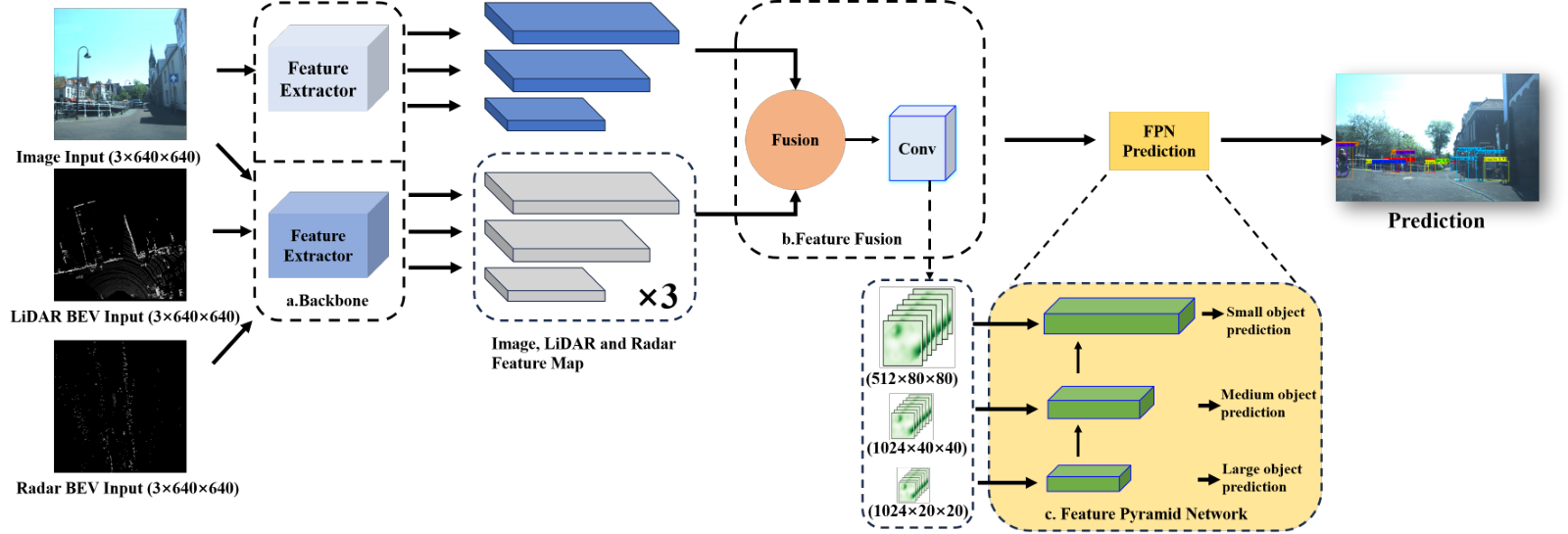
Two-branch backbone
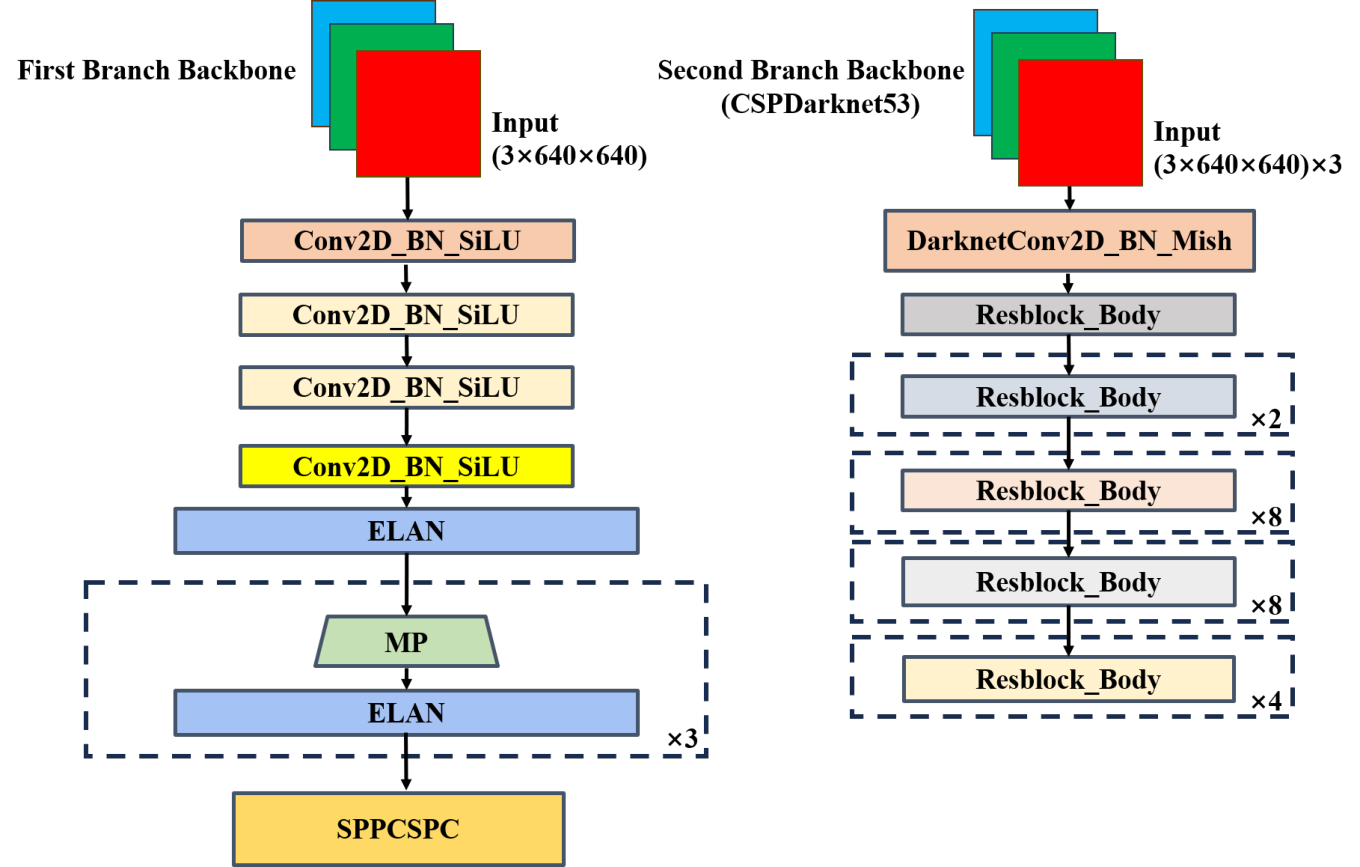
ELAN blocks for the image, CSPDarknet53 residual stages for the two BEV inputs, each producing features at three scales.
Feature fusion
Per-modality self-attention followed by a shared global-attention gate, applied at every scale so noisy radar points are attenuated rather than trusted.
Pyramid network
A PANet-style neck with SPPCSPC widening the receptive field, then three heads for small, medium and large objects.
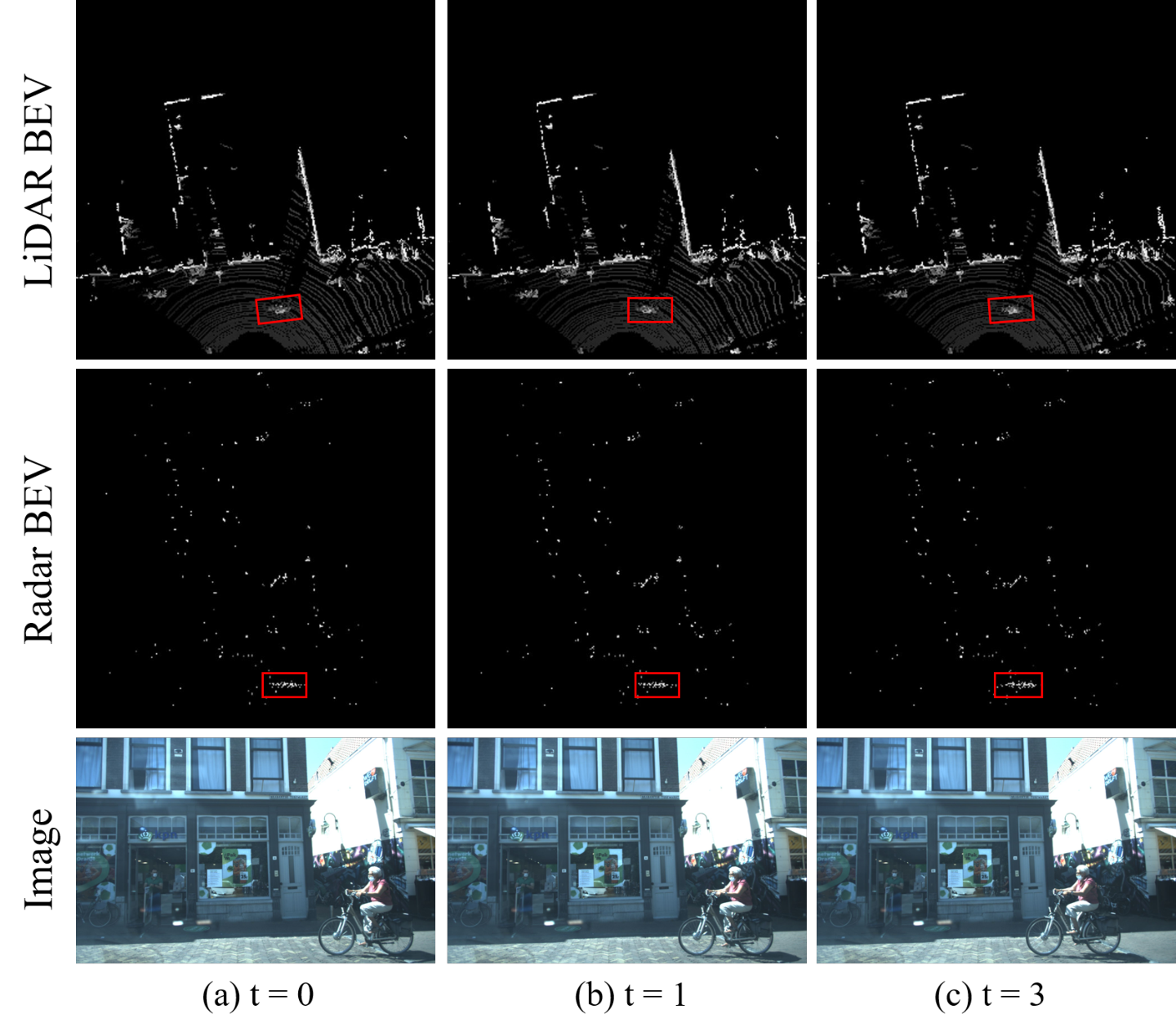
Input representation fig. 1
Point clouds are projected onto a 0.1 m grid over X ∈ [0, 40] m, Y ∈ [−20, 20] m and Z ∈ [−2, 0.5] m. Each cell takes the maximum height of the points that fall into it, normalised to 0–255, which keeps the representation compact enough for mature 2D detection machinery while preserving the geometry that matters.
Results
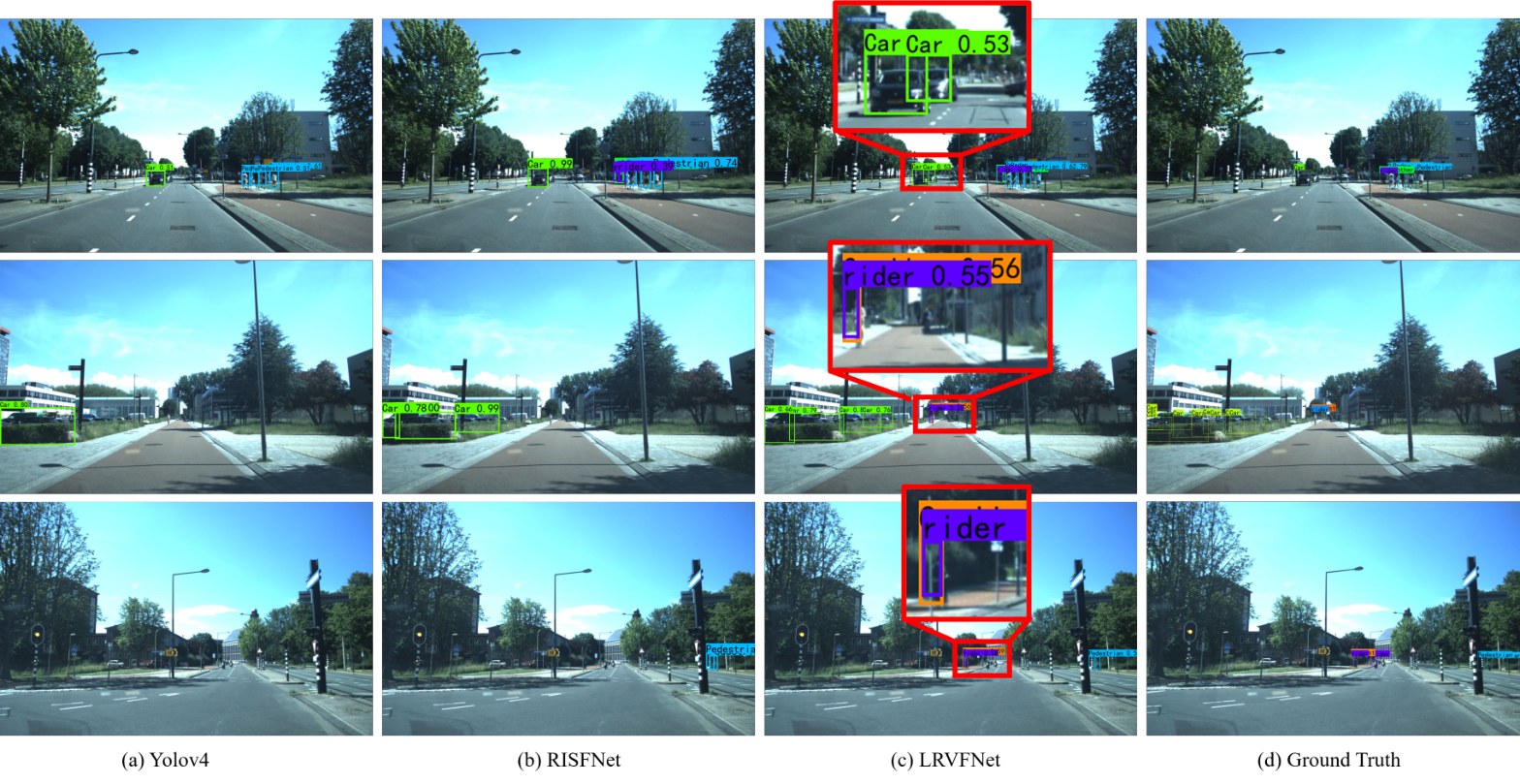
AP is reported at IoU thresholds of 0.35 and 0.50. Adding LiDAR on top of radar is the largest single step; the attention fusion adds the rest.
| Modality | Method | AP35 | AP50 |
|---|---|---|---|
| Image | YOLOv4 | 31.06 | 29.78 |
| Image | YOLOv7 | 83.74 | 80.65 |
| Image + radar | RISFNet | 66.78 | 45.55 |
| Image + radar | LRVFNet | 88.30 | 85.03 |
| Image + LiDAR + radar | RISFNet | 76.72 | 54.23 |
| Image + LiDAR + radar | LRVFNet | 89.37 | 86.50 |
| Modality | Method | AP35 | AP50 |
|---|---|---|---|
| Image | Faster R-CNN | 77.35 | 57.58 |
| Image | YOLOv4 | 78.46 | 57.04 |
| Image | EfficientDet | 78.62 | 58.52 |
| Image | FCOS | 68.71 | 58.56 |
| Image + radar | CRF-Net | 79.63 | 57.74 |
| Image + radar | Li et al. | 85.28 | 64.64 |
| Image + radar | RISFNet | 90.05 | 75.09 |
| Image + radar | LRVFNet | 91.12 | 78.46 |
Running it
The environment is pinned with uv: Python 3.10 and PyTorch 1.13.1 built for CUDA 11.7.
Pretrained CSPDarknet53 backbone weights come from the Hugging Face Hub and are
fetched automatically when pretrained=True.
# clone and build the environment
git clone https://github.com/nubot-nudt/LRVFNet.git
cd LRVFNet && uv sync

# train, or run inference on one frame
uv run python train.py
uv run python infer.py
A synthetic dataset generator is included, so the whole pipeline can be checked end to end before a real dataset is in place.
Citation
@article{xiao2023lrvfnet,
  title   = {Deep LiDAR-Radar-Visual Fusion for Object Detection
             in Urban Environments},
  author  = {Xiao, Yuhan and Liu, Yufei and Luan, Kai and
             Cheng, Yuwei and Chen, Xieyuanli and Lu, Huimin},
  journal = {Remote Sensing},
  volume  = {15}, number = {18}, pages = {4433}, year = {2023},
  doi     = {10.3390/rs15184433}
}